
Integrating AI Body Composition Analysis into Telehealth Platforms
Discover how virtual clinics, remote patient monitoring (RPM) developers, and telehealth platforms leverage camera-based AI body scanning to monitor patient skeletal muscle mass, body fat percentage, and visceral fat risk indicators without mailing hardware scales.
verified Published by the WorkoutX team — builders of the exercise GIF API used by fitness app developers. Learn more
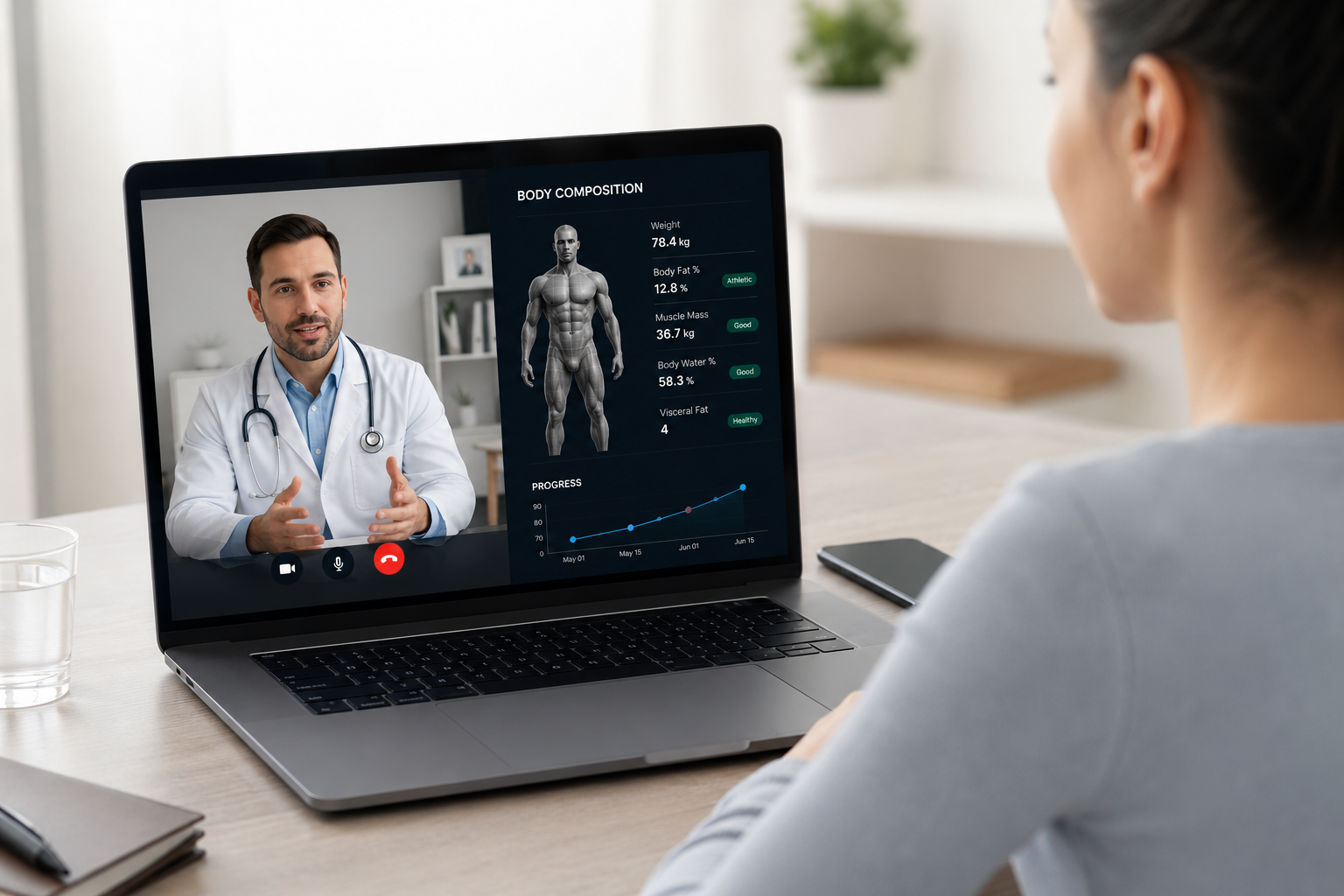
The Evolution of Remote Patient Monitoring (RPM)
Remote patient monitoring (RPM) has undergone a major paradigm shift. Historically, telehealth platforms restricted patient check-ins to simple self-reported weight, blood pressure, and basic pulse oximetry. However, for modern digital health applications—specifically virtual endocrinology practices, digital obesity clinics, and post-surgical recovery platforms—weight alone is a flawed metric.
A patient's weight does not differentiate between fluid retention, skeletal muscle mass, and adipose tissue. For instance, in patients undergoing GLP-1 receptor agonist therapies (such as semaglutide or tirzepatide), tracking muscle wasting (sarcopenia) is clinically vital. If a patient loses 5 kg, but 3 kg of that loss is active skeletal muscle tissue, the clinical outcome is suboptimal. Telehealth platforms need a scalable, remote method to track body composition—specifically lean mass ratio and visceral fat distribution—directly from the patient's home.
Overcoming the Hardware Scale Dilemma
Until recently, obtaining body composition data remotely meant shipping Bioelectrical Impedance Analysis (BIA) smart scales to patients. This hardware-dependent approach presents severe commercial and operational challenges:
- High Capital Expenditure (CapEx): Shipping scales costs $30-$80 per patient, heavily impacting client acquisition costs (CAC).
- Logistical Latency: Waiting for patients to receive, unbox, and calibrate scales delays therapy onboarding by 5 to 7 days.
- Connectivity Friction: Bluetooth pairing and Wi-Fi synchronization issues account for over 45% of technical support tickets in telehealth apps.
- Calibration Drift: Consumer-grade scales suffer from extreme variance based on patient hydration levels, skin temperature, and floor surfaces.
Integrating a camera-based body composition API bypasses hardware altogether. By utilizing the smartphone camera already in the patient's hand, telehealth platforms can onboard patients instantly and start tracking key biometric data immediately.
How Camera-Based Anthropometry Works
Camera-based digital anthropometry extracts structural body metrics by analyzing a single, standard front-facing photo. The WorkoutX Body Scan API utilizes a state-of-the-art computer vision pipeline:
- Pose Keypoint Detection: The system detects anatomical landmarks across the skeletal frame to identify joint locations, posture alignment, and height-to-width ratios.
- Volumetric Estimation: Machine learning models reconstruct body segments to calculate localized volume (torso, upper arms, thighs, calves).
- Formula Ensemble Integration: Segment volumes are combined with patient metadata (height, weight, age, biological gender) to output body fat percentage, lean mass index, and 14 distinct circumference estimates.
Accuracy Standard: The visual analysis matches clinical bioimpedance scales and maintains a high correlation (within ±2-3%) to Dual-Energy X-ray Absorptiometry (DXA) scans, the clinical gold standard.
Clinical Use Cases: GLP-1 and Bariatric Care
Telehealth platforms specializing in medical weight loss use AI body scanning to monitor health metrics:
GLP-1 Treatment Monitoring
GLP-1 medications can lead to rapid weight reduction, but up to 40% of that weight lost can come from lean muscle tissue. Clinicians utilize body scans to ensure patients maintain a healthy skeletal muscle index by adjusting dietary protein and resistance training protocols in real time.
Bariatric Pre- and Post-Op Tracking
Bariatric clinics monitor patient visceral fat reduction pre-surgery to decrease surgical risk, and track post-op progress to celebrate fat loss while preserving vital lean tissue.
API Integration Guide & Python Code
Integrating the WorkoutX REST API into your backend is designed to be developer-friendly. Below is a complete Python integration example that posts patient biometrics and processes the JSON body composition metrics:
import requests

api_url = "https://api.workoutxapp.com/v1/scan"
api_key = "YOUR_SECURE_API_KEY"

headers = {
    "X-WorkoutX-Key": api_key
}

# Payload requires standard patient metadata for volumetric calibration
payload = {
    "height_cm": 178,
    "weight_kg": 84.5,
    "age": 42,
    "gender": "male"
}

with open("patient_front_facing.jpg", "rb") as image_file:
    files = {"photo": image_file}
    response = requests.post(api_url, headers=headers, data=payload, files=files)

if response.status_code == 200:
    data = response.json()
    print(f"Analysis Complete: ID {data.get('scan_id')}")
    print(f"Body Fat: {data.get('body_fat_percentage')}% ({data.get('body_fat_category')})")
    print(f"Muscle Score: {data.get('muscle_score')}/100")
    print(f"Lean Mass: {data.get('measurements', {}).get('lean_mass_kg')} kg")
else:
    print(f"API Error {response.status_code}: {response.text}")
HIPAA & GDPR Security Framework
Medical and health applications require stringent compliance with data privacy laws. Telehealth platforms in the United States must strictly adhere to HIPAA (Health Insurance Portability and Accountability Act), while European platforms must satisfy GDPR (General Data Protection Regulation).
The WorkoutX API implements a **zero-photo-retention architecture**. When a patient photo is submitted:
- The image is streamed directly into secure, volatile RAM memory.
- The computer vision pipeline processes the image and extracts numerical vector coordinates.
- The source image file is immediately destroyed from memory.
- No images are ever written to persistent disk storage, ensuring patient photos cannot be leaked, hacked, or intercepted.
Surfacing this stateless security design in your patient UI builds deep clinical trust, alleviating concerns about camera features in health applications.